Tag Archives: Palestine

August 8th, 2014

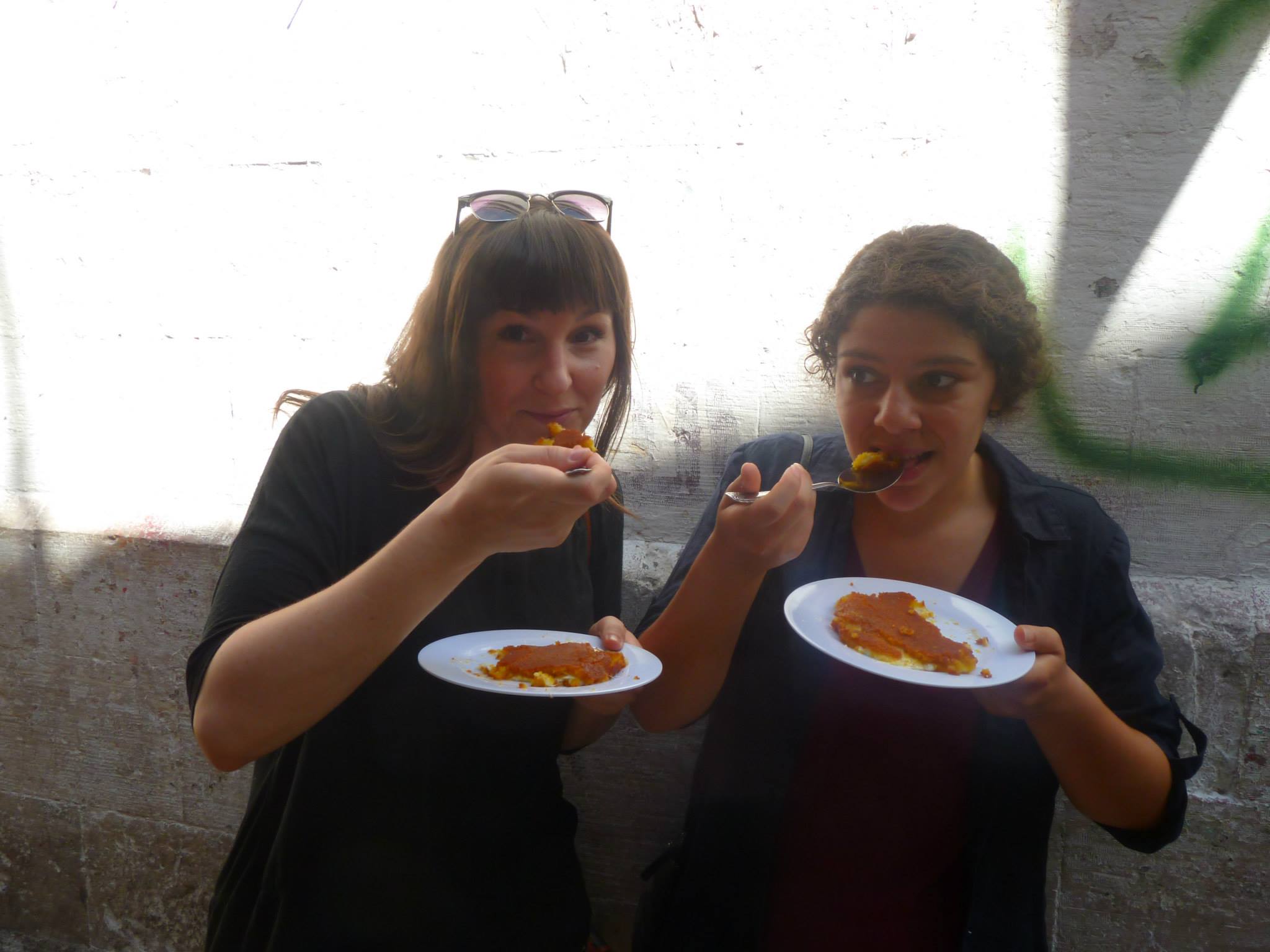
All is safe in Nablus. Occasionally we here gunshots in the distance, but, as I’ve mentioned before, they’re far from here, restricted to the demonstrations at the checkpoints. Even so, Tessa, Giulia, and I spent the day inside our flat. We really needed a couple days to rest after such a hectic week. Yesterday we slept in til noon, and only went out to buy knafeh from the souk. That’s where the best knafeh in town was supposedly located, and we saw the truth of our recommendation upon arrival; the line was out the door, and the server was working nonstop to keep pace. Cut a piece, slide it onto a plate, cut, slide, cut slide. By the time we got a slice, there was no room to sit, so we leaned against the wall and took our first bite. For those of you who haven’t yet had the fortune to taste knafeh: it’s a pastry made of semolina and baked white cheese, then drizzled with syrup while still hot. It actually tastes like happiness.
10562748_10204366474100837_1618535406277872160_o

And looks like it too.

The day the protests were happening, we literally didn’t leave the flat until nighttime. But after dark, our neighbors came down to take us to a party, our first one in Palestine. Ahmad and his mom drove us to this restaurant… but then Ahmad left. I was confused, but just followed his mother down an alleyway and up the stairs to second story.

I have to give some background information before I continue. In Nablus, the most conservative city in Palestine, we get away without wearing headscarves… but just barely. Nobody, not even men, can walk around in shorts and a tank top. Most women have not only scarves, but sleeves to their wrists and pants to their ankles. So it was a shock for me to walk into this secret showroom and watch as a roomful of Palestinian women (literally) let down their hair. Not only did they take off their scarves, but their overcoats, too; and underneath those coats were dresses that would put clubbers in America to shame. We’re talking thigh-length, strapless, sequined, form-fitting, it’s-time-to-go-crazy-at-the-club costumes. And tons of makeup, and tattoos! But they didn’t just undress and start a conversation. Oh no. These girls got on the dance floor, and started rocking out to some Middle Eastern electronic dance music. You don’t know the meaning of bass until you’ve heard the traditional hard beat of a doumbek amplified with four different synthesizers.

I was feeling pretty energized, but hadn’t yet hit the dance floor. Honestly, I felt a little embarrassed of dancing to music I don’t really know. Not that the music wasn’t beautiful – it was – but these girls had their own style of dance that went with it. They twisted their wrists and rocked their hips, moving to the music in a graceful, trance-like, but still edgy and dance-able sort of way… that is, until “Gangnam Style” started blaring over the speakers. Then I was right there with them, and we were all dancing to this ridiculous song the same way an American would.
August 7th, 2014 (The World’s Gone Mad)

Before I talk about what’s going on in Nablus, I feel the need to quickly comment on the state foreign affairs, because frankly, the world’s gone mad. ISIL (or ISIS, depending on whether or not you’re an Archer fan) is killing and taking over cities in Syria and Iraq, with the threat of spreading to Tunisia, Lebanon, Pakistan, and Afghanistan. Lest we forget, these are the guys that AL-QAEDA disowned for being too extremist. Ebola is spreading through West Africa like wildfire, and Boko Haram is still hanging around nearby, killing and raping in the name of Islam. Then, of course, there’s Ukraine in open warfare, with the whole annexation-of-Crimea business. And then, most pertinent to myself at the moment, there’s the fact that Israel is bombing Gaza to smithereens as we speak (or type) and has been for the past month. Add to that the plane shot down over Ukraine, the one downed in Mali due to a storm, and the complete magic-trick that was Malaysian Airlines Flight 370 (all passenger planes), 2014 is looking like a crazy-as-all-hell kind of year. And we still have five months to go.

But back to Gaza. It’s the weekend here in Palestine (Thursday/Friday, because Islam), and we were chilling with the neighbors upstairs, watching the news, when a spokesman for Hamas appeared on the screen. Today is the third and final day of the ceasefire between Hamas and Israel, and the mood is tense in Gaza as night falls. Hamas is demanding that the blockade on Gaza be lifted, and Israel is refusing to respond. Nobody knows what might happen tomorrow.

The one thing that is dependable, however, is the resilience of the people of Gaza. On TV we watched in Gaza City as its citizens paraded by the thousands, showing they are still together and that they’re spirit is not broken. I have to admit, there is a special kind of bravery in that. These people are supporting their community after having been bombed for an entire month. After losing nearly 2000 people to Israeli rockets. After displacing 500,000 civilians. They still want to fight for change. They don’t want it all to have been in vain.

But that means Nablus will host protests tomorrow, on Friday, the holiest day of the week in Islam. Which means I’ll be staying in after the noon prayers, waiting out the IDF arrests and gunshots.

August 6th, 2014

This morning we ate labna and grapes while listening to gunshots. A few days ago, this would have made me tense up and strain my ears for minutes on end, trying to decide whether or not I should make a dash for the bedroom. Now, the other volunteers and I have grown strangely accustomed to the noise. In fact, Tessa, being the musician she is, has formally named it part of the “tapestry of sound in Palestine.” We hear bullets almost every day, although they’re far off and restricted to protest areas, and unlikely to spread, since all the shooting is done by the IDF (the Palestinian protesters don’t actually have guns). There’s zero risk of being shot here in Nablus, but it still feels weird to be so comfortable with such a sound.

The City Cultural Center classes are running smoothly now; Tessa, Giulia, and I no longer feel the need to all go to every single class. Which is good, because according to my (rather unreliable) schedule, we’re up to 16 classes a week between the three of us. Afterwards, Giulia and I went to go teach a new class, this time in Askar refugee camp. Askar isn’t as compacted as Balata, and it’s fortunate enough to have an art center and a women’s center in addition to schools and health clinics, all funded by the UNRWA. We were told the class was at the art center, so we sat out front and waited for Habib to open the building. After ten minutes Habib was still a no-show, but someone was watching us from the house across the street. Two kids, no older than ten, were shyly peeping at us from behind the green front gate. I tried saying hi to them, but they immediately ran indoors. Giulia and I went back to waiting. It was getting really hot outside, and beads of sweat were forming on our brows and arms.
Suddenly, the gate opened, and the younger boy came running across the street, straight for us. He stopped abruptly at the foot of the steps and asked us, “Bidik Ahwe?” (“Would you like coffee?” in Arabic). Giulia and I looked at each other. Habib still wasn’t here, and we had nothing better to do, so we followed the kid back to the house.

Inside was the other boy, a girl, and their mother, who brought us steaming Turkish coffee. It was surprisingly refreshing, despite the heat. Nobody in the family knew English, so we practiced our Arabic, awkwardly but successfully getting across that we were music students from Italy and California, come to Nablus to teach for Project Hope. The mother smiled and asked us more questions: Were we teaching at the arts center? Do we know Habib? What do we play?

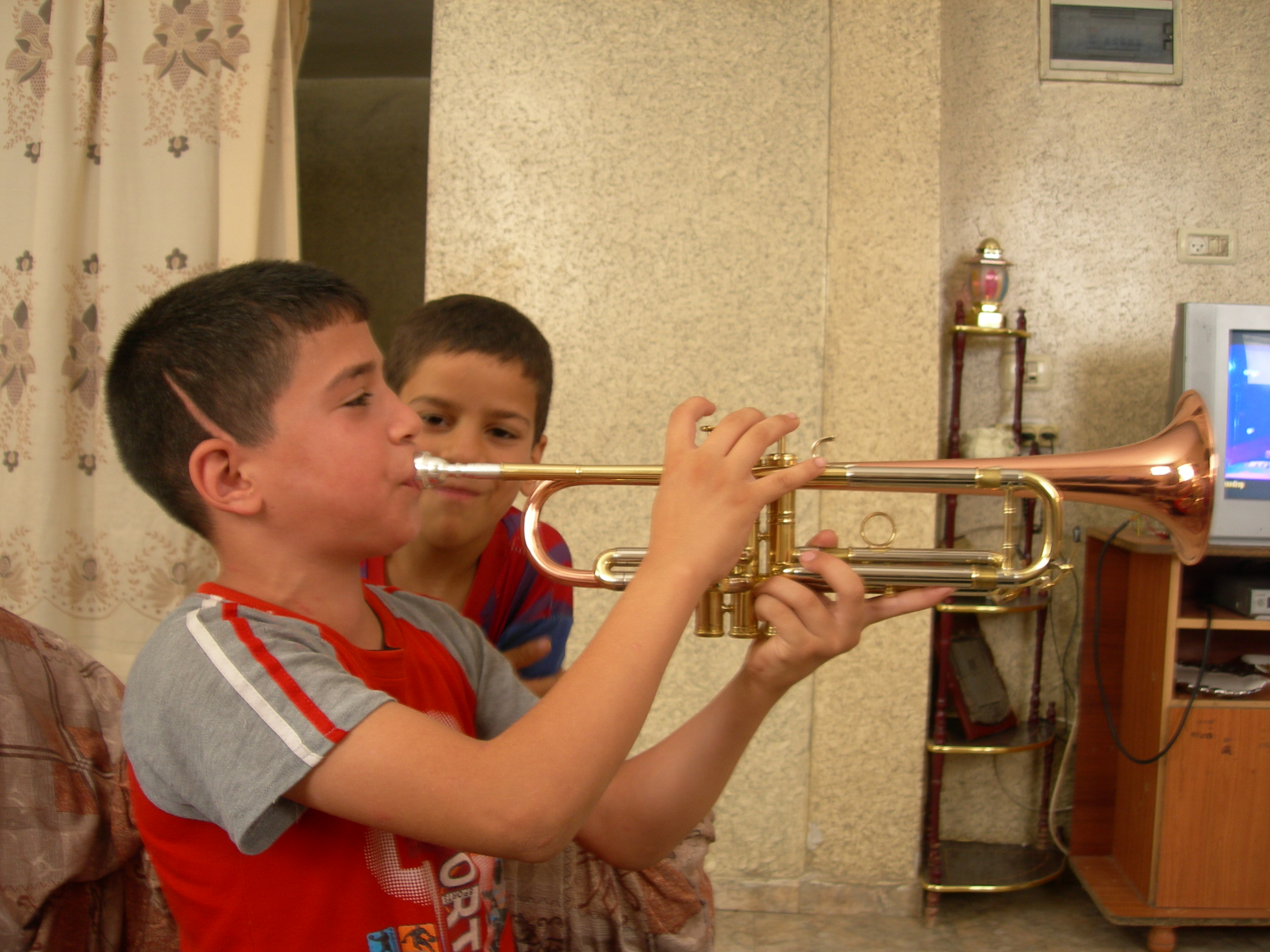
Meanwhile, the older boy started messing with my trumpet case, tapping it and looking it up and down, like it was a cage containing some small, exotic animal. Finally, I unzipped the cylindrical case and pulled out my Kanstul trumpet. And the kid immediately grabbed for it, almost knocking it out of my hands. A little wary, I told him to be careful, but let him play with it while I reached for a mouthpiece. He puffed up his cheeks and whooshed a ton of air at the lead pipe, to no avail. I laughed and demonstrated for him, letting loose a bright tone, before handing the instrument back to him. He caught on quickly.

DSCN3969DSCN3967


Finally, we received a call from Project Hope. As it turns out, the class wasn’t at the arts center at all; it was down the street at the women’s center. We hurriedly finished our coffee, flipped our cups (to read the fortunes) and dashed over.

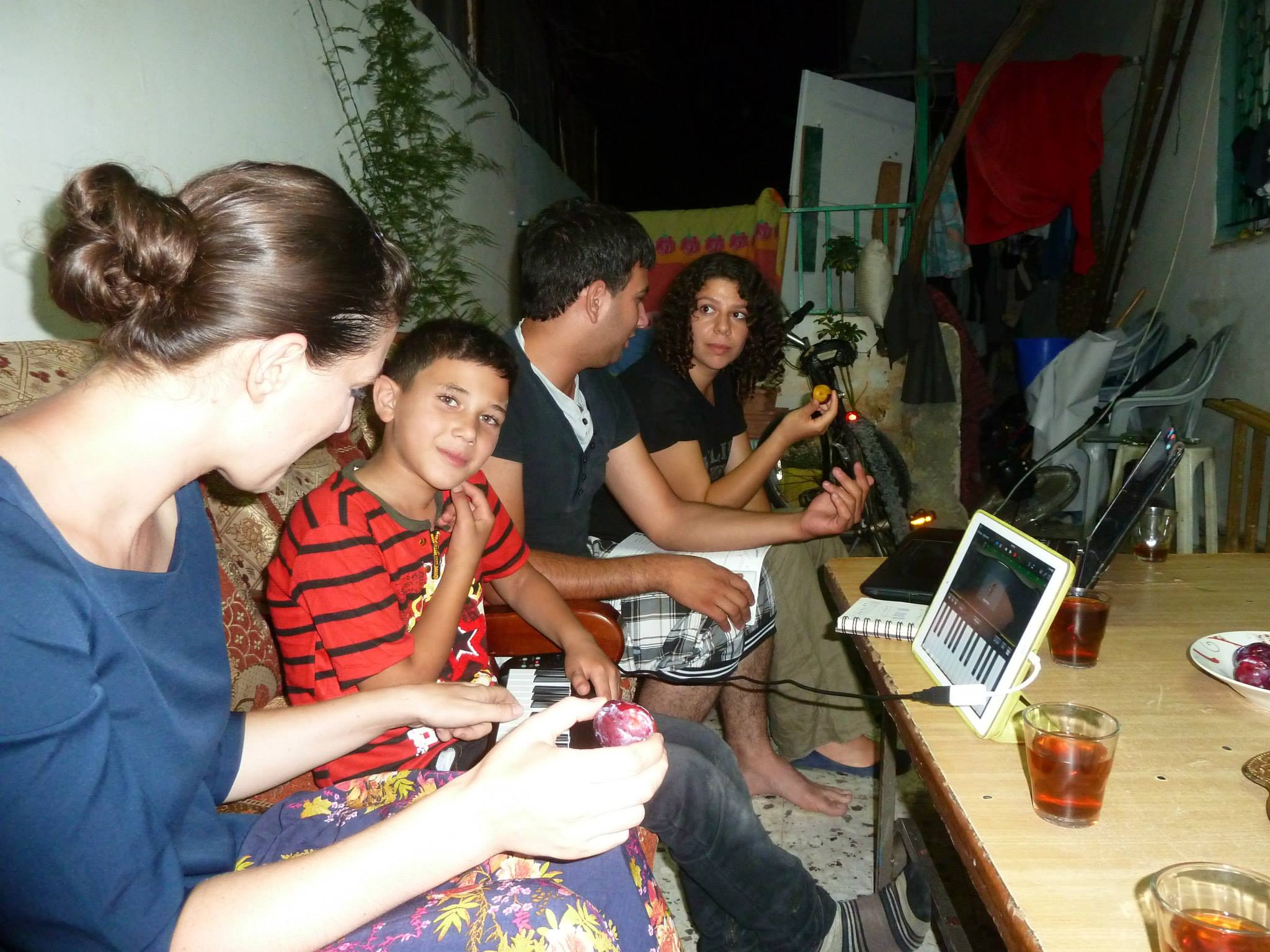
After class, we had lunch with Sego at what is probably the ritziest restaurant in Nablus (we’re talking fish for 120 shekels), and later, after a nap, we climbed upstairs again for coffee and tea with the neighbors. Our large group broke into smaller ones, with different discussions buzzing around the balcony as the sun shrank in the west. It was a learning exchange; Ahmad taught me Visual Basic coding on his laptop, while Tessa and Giulia taught Khalid how to play Happy Birthday. As a music and computer science major, I felt completely in my element.

10582931_10204366453780329_2071411647307017732_o

After we had finished our coffee and figs and mangoes, Khalid and Ahmad’s mother beckoned for us to come with her upstairs. We climbed, one story after another, until we were five or six floors up. I had no idea the building was so big. We emerged on a rooftop patio, sheltered by an awning heavy with grape vines. I know I’ve already described various viewpoints overlooking Nablus, but this was different. From up here we could see the two mountains that form Nablus’s valley in their entirety, as well as the northeastern and southwestern ends of the city. The city sparkled below us and hummed with traffic and nightlife. Suddenly there was an explosion, and our eyes snapped to the center of the city. But instead of fighting, we saw fireworks. Green, white, red: the colors of Palestine.

August 5th, 2014

I woke up this morning to Khalid practicing his piano nursery rhyme on the floor above me. It was 7:30 in the morning. The kid is dedicated.

We had two classes today: one at the Cultural Center, and the other in a town called Sebastya, about a half an hour away from Nablus. Both classes went extremely well. Our lesson plan was ironed our after its we piloted it yesterday, and the kids in both classes were eager and cooperative. They seem to enjoy vocal exercises the most, even if we’re just going up and down the scale, because that’s when they get to interact most directly with the music.

10009304_10204351671850790_8939305459662382155_n

It’s getting harder and harder to find time to write; each class takes at least two hours, between lesson planning, transportation, and the class itself. And of course, we now have Khalid to teach during the evenings.
At 7:50 pm he knocked on our door, ten minutes before the scheduled time. That’s actually huge, considering most people here are at least ten minutes late to just about everything (though I should mention that our students haven’t been late once yet). I was pretty tired, but I invited him in and we got started immediately. The funny thing about Khalid is that most of the time, he’s an uncontrollable ball of energy, but the second you put a piano in front of him he becomes this focused, perfect student. Yesterday, he only knew the piano keys by numbering them. Today, I taught him Solfege, and he immediately, intuitively made the connection between Do and 1, Re and 2, etc. By the time I sent him on his way, he was playing his nursery rhyme from memory, without numbers, and playing with new combinations of notes. I was grinning like mad for fifteen minutes; it’s unreal to witness this kind of progress, especially when you had a hand in it.

August 4th, 2014

We had our first class today, and as far as first classes go, I’d say we did alright. A little awkward in terms of flow, but that was to be expected, given the fact that we had about a day and a half to come up with our first lesson plan. This class was at the Nablus Cultural Center, just a few blocks away from Project Hope, and it’s probably where we’ll be teaching most often. At least, that’s what we’ve been told. Timing is pretty whack here; fashionably late is considered punctual, and I’ve learned not to trust the schedules we’re given. Our translator showed up fifteen minutes into the hour-long class, which meant Giulia, Tessa, and I spent that time awkwardly introducing ourselves in Arabic to a group of giggly eight year-olds.

But the nice thing about music is it’s literally the most basic form of communication, so it’s not hard to get across to these kids what we want them to do. It’s crazy how intuitive a four-four rhythm is, or even the Solfege scale (Do-Re-Mi). Imagine not knowing how to tell someone you want them to sing, but being able to successfully conducting them in choir to “O alele!”.

Back at Project Hope, we checked in and said hi to some of the other volunteers. Our coordinator gave us the day off, and since we haven’t had a free moment since coming here, we took the opportunity to practice a bit before heading back to the flat. I went out to the stone balcony with my trumpet and started playing. I knew it wouldn’t be long before one of the neighbors yelled at me to stop, but from that spot I could see all of Nablus in the valley below, and I wanted to take in the view as much as possible. Like I thought, the door to the neighboring balcony opened up just a few minutes later. A little boy ran out, leaned over the balcony, and started yelling, “Bekefi!” to the ground (“bekefi” means “stop” in Arabic). At first I was confused, but when I realized what he was doing, I almost gave myself away by laughing; the acoustics were making the sound from my trumpet ricochet off the walls and ceiling and finally down into the valley, so it sounded like I was playing from right under his building. We were only three meters away from each other, but he never even saw me.

That night, we went upstairs to meet our landlord and his family. We ended up staying for two hours, drinking tea and eating figs and talking politics. It’s impossible to have a conversation here without politics entering into it; the occupation is such a part of life in Palestine that politics are tied to everything from education to holidays to what you’re eating for dinner.

Before we left, the youngest son, Khalid, ran up to us with a tiny piano keyboard and asked us to teach him music. We showed him a nursery rhyme, and he became absorbed with it, practicing it over and over again as everyone else continued talking.

We were practically adopted by the time we finally made it downstairs. As Ahmad, the eldest son, put it, “I had only one sister. Now I have three more!”


August 3rd, 2014

Today is Sunday, and classes start tomorrow. We’ve only been here a day, but hey, no pressure.

Project Hope sent me, my flatmates, and three other volunteers to Balata and Askar, two of the refugee camps adjoining Nablus. As the taxi neared Balata, I began preparing myself for — well, I don’t know what I was expecting. Tents? Campfires with families huddled around? Sadness and Ruin, everywhere you look? But no. In reality, Tel Balata looks like a small section of any other crowded city. White skyscrapers are huddled together, lining both sides of a main street where all the street vendors gather.

Not that Balata doesn’t have its differences. It is, after all, a refugee camp. 30,000 people are jam-packed into the one squared kilometer that the camp is allowed to reside on. The people can’t expand horizontally, so they build vertically. The result is a forest of huge, looming skyscrapers, built so close together that you’d have to squeeze to get through the alleys. We were only allowed to wander these alleyways with a guide. To some people here, there is no distinction between foreigners; if you’re not Palestinian, you’re Israeli, and that can cause trouble.

But as we wandered Balata camp, we saw no signs of hostility whatsoever. In fact, we mostly saw children: tons of them, running through the alleys, riding their bikes down the main street, playing soccer in the few open spaces. They ran up to us and yelled in English, “Hi! How are you! What is your name!” I don’t think they could understand a word of our response, but they giggled like mad when they realized they were successful in making themselves understood to foreigners.

At the next camp, Askar, we met the director of an arts center,  who invited us in for black ginger tea. After introducing himself and discussing the volunteer projects with us, he steered the conversation towards Palestine. “What do you think of this country?” he asked us.
“It’s nice,” one volunteer said.
“Beautiful, even.”
“Everyone is so hospitable.”
He listened and nodded. Then he leaned back into his chair and said, “I don’t like it here. I don’t like the situation. But I don’t want to leave. Palestine is mine but it’s not mine. We have this land, but we don’t have Gaza, we don’t have Haifa or Jerusalem, we don’t have freedom. We have to claim it, even if we don’t really have it.”

He told us then of some of the horrors happening in Gaza. One man was found stumbling in the streets with a bag full of meat. It was his son. He had been “shredded” by a brand new type of Israeli missile. They pack tiny shards of metal tight around an explosive and send it over into overcrowded Gaza. When it hits, the missile explodes and the fragments rip through the flesh of anyone within an 80 m radius. I’ve heard kinder descriptions of hell. I don’t think anything I ever read in a book will measure up to the atrocities committed by really human beings.

The rest of the evening was much lighter. We did a little shopping for dinner: three huge eggplants for one shekel, mangoes for two, tomatoes and mint and onions for four. That’s, like, two and a half US dollars in total. The broke college student in me almost cried.

10293658_10204342522742068_4117872985980119186_o

With these ingredients, we made a really delicious pasta with some fruit on the side, and three English teachers from Project Hope joined us for dinner. One is from Toronto, the other Montreal, and the last is from London. That makes three Canadians so far, one Londoner, one Italian, and me. More volunteers are set to arrive tomorrow.

August 2nd, 2014

Having just come from Brandenburg in Germany, images of the Berlin Wall are fresh in my mind. More than 100 km long and 3.5 m high, it stood as a functioning symbol of oppression for nearly 30 years, before finally being brought down in the reunification of West and East Berlin. I was amazed as I looked at this wall that divided an entire city, with every square inch of it covered in expressive graffiti that protested the segregation.

The Berlin Wall was nothing compared to what I passed on my way to Nablus today.

After meeting for the first time over coffee, the other volunteers and I climbed into a bus that runs from Jerusalem to Ramallah, crossing the Green Line which supposedly divides Israel and Palestine (I say “supposedly” because Israel tends to view this internationally-sanctified line as a general guide, erring on the side of Palestinian land). Along this line runs the Israeli West Bank Barrier. That’s the formal name for this huge slab of concrete, barbed wire, and sniper turrets that stretches for at least 650 km from North to South. At 8 km high, it is twice the size of the Berlin Wall, it symbolizes the systematic oppression and segregation of Palestinians that was begun 66 years ago, in 1948. And like the Berlin Wall, Palestinians have been painting it over with artwork decrying the occupation.

DSCN3941
Luckily, it didn’t take us too long to pass into Occupied Palestine. We reached Ramallah soon after that, and then it was only a forty-minute taxi ride to Nablus.

The first thing we did was check in with Project Hope, which is Music Harvest’s partner organization in Nablus. While Music Harvest sends volunteers to teach music in Palestine, Project Hope organizes a broad range of volunteers, from English and French teachers to translators and administration. We signed the documents we needed to sign, and then Hassan, our new Arabic teacher, showed us where we will be living for the next month and a half.

The flat consists of three large bedrooms, a living room, kitchen, and bathroom, which I would share with Tessa and Giulia, the other two Music Harvest volunteers, whom I met in Jerusalem that morning. With our own rooms and free Wi-Fi, we figured we’d settle in pretty quickly. But it wasn’t long before we were up again, following our translator, Anas, around for a quick tour of Nablus.

The second largest city in Palestine after Jerusalem, Nablus consists of one large city and three refugee camps, with a total population of around 192,000. It’s nestled in a valley, and as Anas led us down into the Old City center, the city grew dense with chocolate and nut shops, cafes, boutiques, fruit stands, taxis, and people going about their daily business. Most were Muslim, and as you look around you see a sea of colorful headscarves, as much a fashion statement as any other item of clothing. Right in the middle of Nablus sits a modern mall opposite the entrance to a souk, which is probably as old as Nablus itself. It’s into this souk that Anas led us, to show us the heart of Nablus.

Without him, we would have gotten lost. The souk is a maze of shops selling everything from olives to ceramics to clothes and towels. From all sides, butchers and fruit vendors yell or even sing their offers at you, and customers are constantly squeezing around you as they make their way to one store or another. After a several turns, we came to a cafe, where Anas had us buy falafel. One sandwich was only two and a half shekels, about 80 cents in US dollars… and it was some of the best falafel I’d ever had. On the way back up to our flat, I was seriously considering the logistics of eating falafel three times a day for six weeks.

My flatmates and I finished that long day by chilling out and making pasta. Giulia’s Italian, so she directed the cooking, “the real Italian way.” While waiting for it to boil, I practiced trumpet for the first time in weeks. I sounded like shit, but it felt good to know I would be falling back into the old practice routine.

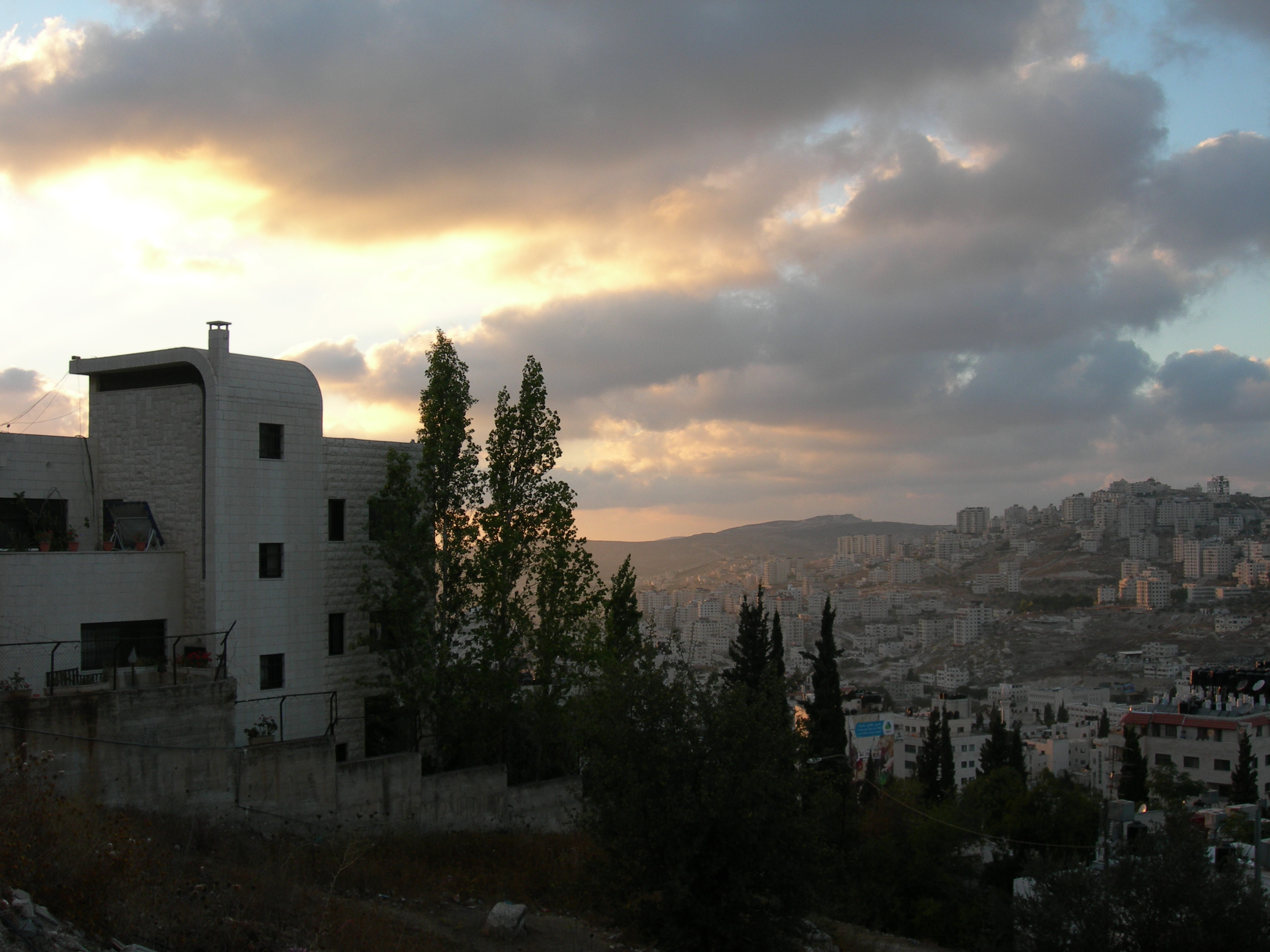
Right before bed, I went outside and managed to catch the Adhan from the mosques and my first sunset in Nablus. It looked like this:
DSCN3951

August 1st, 2014

From the third story of Jaffa Gate Hostel, I can see two churches, a mosque, and a synagogue poking through the blanket of rooftops and souks that is Old Jerusalem. Noor, the innkeeper, insisted that I come up here to catch the view. His hostel looks like it’s been hollowed out of some huge stone house, with each room resembling a brick cave, stuffed with beds. Even so, I’m one of the only guests here; most have cancelled due to what they’ve read in the news.

But the sky is perfectly clear – not only of clouds, but of rockets. The city is quiet, and the police, though intimidating and thick in the streets, are bent on keeping it that way. Far from the conflict in Gaza, I actually feel safe here.

Not like in the airport. I was “randomly selected” for a strip search, probably due to having multiple Arab stamps in my passport. That, and the fact that my final destination was the West Bank. I felt bad for Sophie and her mom, who, along with the rest of their family, had been taking care of me all week in Germany; they had to watch from behind a rope as I was grilled by airport security for twenty minutes. “Why did you visit Lebanon? Jordan? The UAE? What’s your father’s name? And his father’s name? Why are you going to the West Bank? Don’t you know it’s dangerous? What’s in that case?” And so on.
Then, they had to wait as I was led off to the side, where I would undergo a full-body physical search. Honestly, I had expected this, and thought it was a little funny that a 19 year-old girl toting around a trumpet was threatening enough to bother spending an extra hour and a half on. At the same time, I was a little red, a little nervous, and actually feeling guilty. Even though I had told nothing but the truth up until that point, the intense, repetitive questioning made me feel like I was trying to cover up some terrible plot. It wasn’t until later that I realized I shouldn’t be made to feel like a criminal just because I’m an Arab wanting to reach the West Bank.

The physical itself was fine. In fact, it was very calm. One of the security guards tried to make small talk while checking my socks; imagine hearing “So what’s the weather like in California?” while someone’s searching between your toes for weapons of mass destruction.

I’m being honest when I say that the worst part, the most nerve-wracking thing, was when they asked me to fully take apart my trumpet. I gently disassembled it and placed each piece of brass in a red plastic bin. Then the security guard grabbed the bin and rushed out, jostling the pieces as he went. It got through okay in the end, though. The same guard who asked me about California struck up a conversation about the trumpet (she plays guitar herself). I liked her. Clearly the good cop, as opposed to the woman from Haifa who thought I was an idiot for wanting to teach music in the West Bank. The thing is, though, I think my instrument was possibly the reason the search didn’t stretch on for longer, or that I wasn’t flat-out turned back to America (as is typical of many Arabs and Arab-Americans wanting to reach Israel nowadays). After talking to me about music and why I chose Palestine to teach it, the good-cop security guard sped up the searching process, explained my situation to her colleagues, and quickly led me straight to the airplane, cutting ahead of a line of people checking in and stamping passports. Then again, that’s exactly what the good cop is supposed to do. That, and give you free snack vouchers as recompense for time and dignity lost during a strip search.

10480061_10202527389730669_4709499231244340987_o

Where to begin…

Obligatory introduction to blog:

Welcome to my very own mooched-off-Wordpress corner of the internet. Originally, I just wanted to create a temporary blog so I could update my friends and family about my current situation without typing enough emails to digitally drown myself in. Those close to me know that for the next six weeks, I will be teaching music as a volunteer in the West Bank, which in some respects is a war zone right now (though in general, life continues as usual). However, many of those same people also know that I keep a journal religiously, and I figured this would be as good a time as any to start putting my writing online.

This blog falls at the intersection of several of my major interests right now, including music, travel, writing, language-learning, and communication. Seeing how I don’t plan on discontinuing any of those interests anytime soon, this blog could potentially go on for quite a while.

But for now, it’s focused on Nablus in the West Bank, Palestine, where there is so much going on in terms of culture and politics that my head has been spinning since arriving here this morning.